
Smart Film for Vertical Farming: Powering the UAE's High-Tech Food Future
The UAE imports the vast majority of its food, a dependency that has pushed food security to the top of the national agenda. Add a harsh desert climate, intensifying heat driven by climate change, and rapid population growth, and the case for producing food closer to where people live becomes urgent rather than optional.
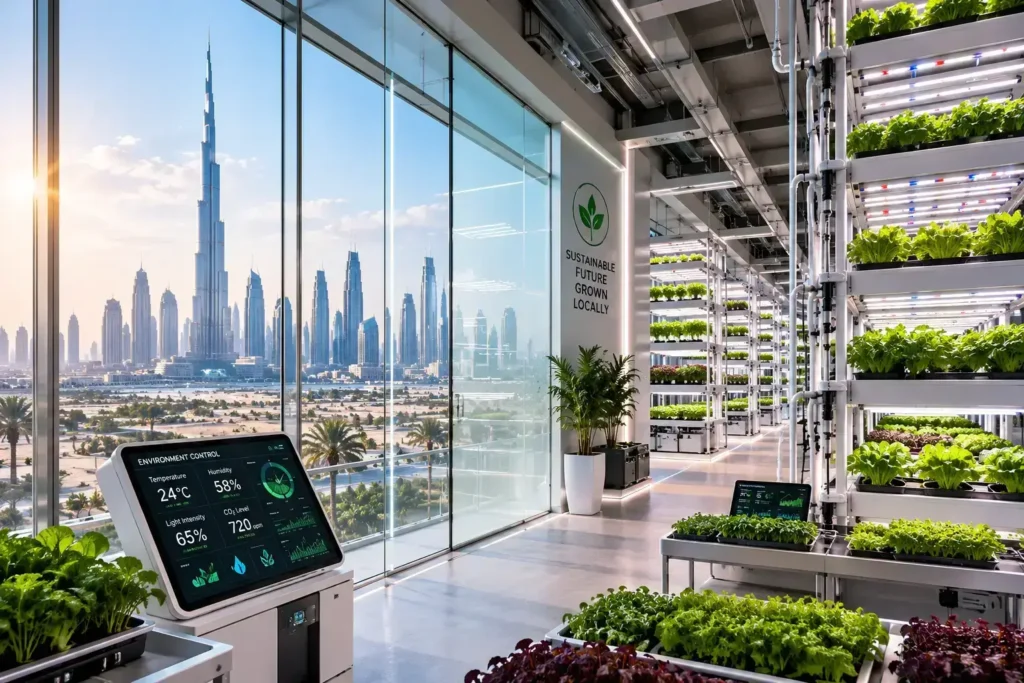
Controlled Environment Agriculture (CEA) — and vertical farming in particular — has emerged as one of the UAE’s most promising responses. By growing crops indoors, in stacked layers, under precisely managed conditions, vertical farms can produce food year-round regardless of outdoor temperature or water scarcity. This model aligns directly with the UAE’s Smart Cities initiatives and its Net Zero 2050 sustainability commitment, both of which favour technologies that reduce resource consumption while improving quality of life.
But CEA facilities, especially those built with extensive glazing, face a fundamental engineering challenge: how do you let in enough light for photosynthesis without letting in the punishing solar heat that comes with it? This is where switchable smart film technology has become a genuinely important part of the conversation — not as a cosmetic upgrade, but as a functional layer of the growing system itself.
What Is Vertical Farming?
Before exploring the technology, it helps to establish what vertical farming actually involves, since the term is often used loosely.
Vertical farming is a method of growing crops in vertically stacked layers, typically indoors or within controlled structures, rather than across open fields. It relies on a combination of techniques designed to maximise yield per square metre while minimising resource use:
- Hydroponics — growing plants in nutrient-rich water instead of soil
- Aeroponics — suspending plant roots in air and misting them with nutrient solution
- Controlled environments — precise regulation of temperature, humidity, and CO₂
- LED lighting — supplementing or replacing natural sunlight with tuned light spectrums
- Water efficiency — closed-loop irrigation systems that recycle water rather than losing it to evaporation or runoff
Because vertical farms are largely insulated from outdoor weather, they enable a form of urban agriculture that can operate inside warehouses, repurposed buildings, or purpose-built glass facilities located close to city centres — shortening supply chains and reducing transport emissions.
Why Vertical Farming Is Growing in the UAE
Several converging factors make vertical farming particularly relevant to the Emirates, more so than in many temperate climates.
Desert climate and water scarcity. Traditional open-field agriculture in the UAE faces extreme heat, poor soil quality, and limited freshwater. Vertical farms sidestep these constraints by creating an artificial, optimised growing environment indoors.
Food security policy. The UAE National Food Security Strategy has set clear ambitions to increase domestic food production and reduce reliance on imports, positioning local, technology-enabled agriculture as a strategic priority rather than a niche experiment.
Population growth and urbanisation. A growing, increasingly urban population raises daily demand for fresh produce, and vertical farms sited near population centres can meet that demand with shorter supply chains.
Government-backed smart agriculture initiatives. Various free zones, innovation hubs, and public-private partnerships have actively courted CEA and agri-tech investment, giving the sector institutional momentum that pure market forces alone would take much longer to build.
What Is Smart Film?
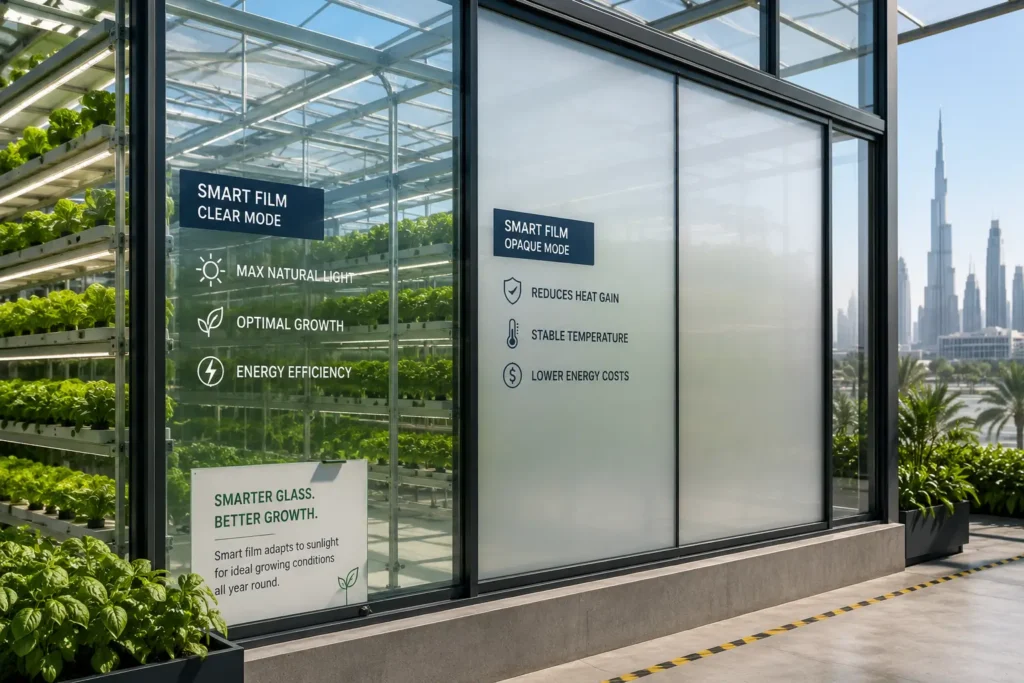
Smart film is a switchable glazing technology, most commonly based on Polymer Dispersed Liquid Crystal (PDLC) technology, that changes the transparency of glass on demand.
How it works. A thin film containing microscopic liquid crystal droplets is laminated between layers of glass or applied directly to existing glazing. When an electrical current passes through the film, the liquid crystals align, allowing light to pass through and rendering the glass transparent. When the current is switched off, the crystals scatter randomly, turning the glass opaque or translucent.
This switching behaviour gives facility operators direct, on-demand control over several properties that matter enormously in agricultural applications:
- Light transmission — adjusting how much visible light reaches the growing area
- UV protection — reducing ultraviolet exposure that can degrade materials and stress certain crops
- Infrared rejection — blocking a significant portion of the infrared spectrum responsible for solar heat gain
- Solar heat reduction — lowering the overall heat load transmitted through the glazing
Durability and installation. Smart film can be installed as a retrofit onto existing glass panels or specified into new glazing during construction, giving facility owners flexibility depending on whether they are upgrading an existing structure or designing a new one. Properly installed film is built to withstand continuous cycling between clear and opaque states over an extended operational lifespan, though actual longevity depends on product quality, installation standards, and environmental exposure — details worth confirming directly with a manufacturer or specialist installer for any given project.
Key Takeaway: Smart film isn’t just a privacy or aesthetic feature. In a vertical farming context, it functions as an active thermal and light-management layer that directly affects crop performance and energy costs.
Smart Film vs Traditional Glass in Vertical Farms
| Factor | Traditional Glass | Smart Film (PDLC) |
|---|---|---|
| Heat gain control | Passive; limited without added shading or coatings | Active; heat load can be adjusted on demand |
| Energy efficiency | Relies heavily on HVAC to offset solar gain | Reduces cooling load, easing pressure on HVAC systems |
| Light control | Fixed transmission; requires external blinds/shades | Adjustable transparency without additional hardware |
| Privacy | Requires separate blinds, curtains, or frosting | Built-in opacity switching |
| Retrofit capability | Requires full glass replacement for upgrades | Can often be applied to existing glazing |
| Maintenance | Standard glass cleaning only | Standard cleaning plus occasional electrical/system checks |
| Automation potential | Minimal without added sensors and motorised shading | Naturally suited to sensor and BMS integration |
| Upfront cost | Lower initial cost | Higher initial cost, offset by operational savings over time |
Why Smart Film Is Ideal for Vertical Farming
Heat Reduction
Solar radiation entering through glass carries both visible light and infrared heat. In a densely glazed vertical farm, this creates a pronounced greenhouse effect — heat accumulates faster than it can dissipate, driving up internal temperatures. Left unmanaged, this places enormous strain on HVAC systems working to keep growing zones within the narrow temperature bands that most crops require. By actively rejecting a portion of infrared radiation and allowing operators to reduce transparency during peak solar hours, smart film directly lowers the cooling load the building’s mechanical systems need to overcome, which in turn supports more stable, energy-efficient operation.
Light Optimisation
Not all light is useful to plants. Crops rely on Photosynthetically Active Radiation (PAR) — a specific band of the light spectrum — to drive photosynthesis. Excess light beyond what a crop can use doesn’t accelerate growth; it can instead cause light stress, uneven canopy development, or bleaching in sensitive species. Smart film allows operators to fine-tune how much light reaches the growing area, supporting more uniform growth across a facility. When paired with automated shading logic, transparency can shift throughout the day in response to real-time light intensity, helping maintain consistent conditions for crop-specific lighting requirements.
Energy Savings
Because HVAC systems in glass-enclosed agricultural facilities often represent one of the largest ongoing operating costs, any reduction in cooling demand has a direct effect on the facility’s energy bill. Lower solar heat gain means air conditioning and dehumidification systems don’t have to work as hard, which supports lower electricity consumption over the life of the building. Over time, this contributes to a more sustainable, cost-predictable operation — an important consideration for facility managers evaluating long-term operational budgets rather than just construction costs.
Crop Protection
Temperature stability matters as much as temperature level. Fluctuations caused by uncontrolled solar gain can stress plants, slow growth cycles, or reduce yield consistency. By moderating heat and light input, smart film helps maintain more stable growing conditions throughout the day, which supports healthier crop development and more predictable output — a meaningful advantage for commercial operations where yield consistency underpins profitability.
Sustainability
Reduced HVAC dependence translates into lower energy demand and, by extension, a smaller carbon footprint for the facility. This positions smart film as a relevant component within broader green building strategies, including projects pursuing sustainability credentials or reporting against ESG frameworks. It’s worth noting that any claims around specific certifications (such as LEED) should be verified against the actual building’s certification pathway rather than assumed from the glazing choice alone.
Integration with Smart Farming Technologies
Smart film delivers the most value when it operates as part of a connected system rather than as a standalone product. In 2026, most serious CEA projects are designed around integration from the outset:
- IoT sensors monitoring temperature, humidity, and light levels in real time
- AI-driven climate control that adjusts film transparency alongside HVAC and irrigation settings
- Smart irrigation systems coordinated with environmental data to optimise water use
- Building Management Systems (BMS) that centralise control of glazing, climate, and lighting
- Mobile apps and dashboards giving facility managers remote visibility and control
- Weather monitoring feeding external conditions into internal adjustments
- Predictive analytics that anticipate heat loads before they occur, rather than reacting after the fact
This integration is what elevates smart film from a passive material choice to an active component of a facility’s operational intelligence.
Best Applications of Smart Film in Vertical Farms
Greenhouses
Traditional greenhouses benefit from smart film’s ability to reduce midday heat spikes without sacrificing the natural light crops need during cooler hours.
Rooftop Farms
Urban rooftop installations are especially exposed to direct solar radiation; switchable glazing helps manage this exposure without permanent shading structures.
Indoor Farms
Fully enclosed vertical farms use smart film primarily for light management on any glazed sections and for managing heat where natural light supplements LED systems.
Commercial Agriculture
Large-scale operations benefit from the cumulative energy savings across extensive glazed surfaces, where even modest per-panel efficiency gains compound significantly.
Research Labs and Universities
Controlled research environments require precise, repeatable light and temperature conditions — exactly what switchable film is designed to deliver.
Restaurants and Hotels
On-site “farm-to-table” growing displays increasingly use smart film both functionally and as a visible design feature for guests.
Food Production Facilities
Processing and packing areas adjacent to growing zones benefit from the same thermal management, protecting both product and equipment.
Real UAE Examples
The UAE’s agri-tech ecosystem now extends well beyond any single flagship project. Bustanica, one of the world’s largest vertical farming facilities, has drawn significant attention to what large-scale CEA can achieve in a desert climate. Alongside it, initiatives such as Dubai Food Tech Valley are being developed specifically to cluster food technology, agri-tech research, and production under a single innovation-focused ecosystem. Broader Sustainable City developments across the UAE have incorporated CEA and urban farming elements into their master planning, while Abu Dhabi’s agri-tech initiatives continue to support both research and commercial-scale projects.
Collectively, these projects reflect a maturing smart agriculture ecosystem — one where glazing technology, climate control, and digital farm management are increasingly treated as interconnected design decisions rather than separate line items. For the most current details on any specific project’s scale, technology partners, or output, readers should consult the relevant developer’s official publications, as these initiatives evolve quickly.
Cost vs Long-Term ROI
Evaluating smart film purely on upfront cost misses the more relevant question for facility owners: what does it cost to operate the building over its lifetime?
Initial investment. Smart film carries a higher upfront cost than standard glazing, whether installed during construction or applied as a retrofit.
Energy savings. Reduced HVAC load lowers ongoing electricity costs, which compound over the operational life of the facility.
Maintenance considerations. Switchable glazing introduces an electrical control layer, meaning maintenance planning should account for periodic system checks alongside standard glass cleaning.
Equipment lifespan. Reduced thermal and UV stress on interior fittings, lighting systems, and even crops themselves can extend the useful life of associated equipment.
Productivity improvements. More stable growing conditions support more consistent yields, which matters directly to the commercial viability of a farming operation.
Because exact payback periods depend heavily on facility size, local energy tariffs, and climate exposure, prospective buyers should request a project-specific cost-benefit analysis from a qualified specialist rather than relying on generic industry percentages.
Is Smart Film Worth It for Small Farms?
Smaller CEA operations sometimes assume switchable glazing is only justifiable at large commercial scale. In practice, the calculation depends less on farm size and more on glazing area, local climate exposure, and how much the facility currently relies on HVAC to manage heat.
A small facility with substantial glazed surface area in a hot climate may see meaningful relative benefit, particularly if energy costs represent a significant share of operating expenses. Smaller operators are generally best served by requesting a tailored assessment rather than assuming the technology is out of reach — retrofit options in particular can make phased adoption realistic even on a constrained budget.
Future of Smart Agriculture in UAE
Looking ahead, several trends are likely to shape how CEA and vertical farming develop across the UAE:
- AI-driven optimisation of lighting, irrigation, and climate control working in concert rather than as separate systems
- Robotics and automation handling planting, harvesting, and monitoring tasks within controlled environments
- Climate resilience planning, as facilities are increasingly designed with future climate volatility in mind
- Deeper integration with national food security goals, linking individual projects to broader strategic targets
- Precision agriculture techniques adapted from open-field farming into indoor, data-rich environments
Smart glazing technology is positioned to remain a foundational element within this trajectory, since almost every future development listed above depends on precise, responsive control over light and heat — the exact function smart film performs.
Conclusion
Smart film has moved from a niche architectural feature to a functional necessity for glass-enclosed vertical farming in demanding climates like the UAE’s. By actively managing heat gain, optimising light for crop performance, reducing energy demand, and integrating cleanly with modern smart farming systems, it addresses several of the core engineering challenges that CEA facilities face in the region.
As the UAE continues to invest in food security, sustainability, and smart infrastructure, technologies that make controlled environment agriculture more efficient and more resilient will only become more central to how the country grows its food.
Speak with our smart film specialists for a tailored consultation. We’ll help you identify the right solution for your vertical farm, greenhouse, or controlled-environment agriculture project in the UAE — from initial feasibility through installation and integration.
FREQUENTLY ASKED QUESTIONS
1. What is smart film, and how does it work in vertical farming?
Smart film is a switchable material applied to glass that can change transparency with electricity. In vertical farming, it controls light and heat exposure, helping maintain stable growing conditions while improving energy efficiency and plant health.
2. Why is vertical farming important in the UAE?
With limited arable land and high food import dependence, the UAE uses vertical farming to ensure food security. These farms use less water, grow year-round, and are sustainable in harsh climates when supported by technologies like smart film.
3. Can smart film help reduce farming costs?
Yes. Smart film reduces the need for heavy cooling systems and artificial shading, leading to lower electricity bills. It also extends equipment life by maintaining consistent indoor conditions, cutting long-term costs for farmers in high-temperature environments like the UAE.
4. How does smart film affect crop quality?
By filtering excessive heat and light, smart film prevents stress on crops, leading to better yields, color, and taste. It also reduces exposure to pests and pathogens by keeping environments sterile and minimizing external visibility.
5. Is smart film difficult to maintain?
No. Smart film has a smooth, durable surface that’s easy to clean and requires minimal maintenance. Its sealed application prevents dust and moisture from affecting the film, making it ideal for UAE’s dusty environment and hygienic farming operations.
6. Can smart film be automated with smart farming tools?
Yes. Smart film can be integrated into smart farming systems and controlled via mobile apps or IoT dashboards. This allows farmers to adjust transparency levels based on time, weather, or crop needs automatically, adding precision to the farming process.
7. Is smart film eco-friendly?
Smart film is energy-efficient and helps reduce cooling loads, thus cutting greenhouse gas emissions. It also contributes to sustainable building certifications like LEED, making it a strong choice for eco-conscious farms and urban developments.
8. Are there government incentives for smart farming in the UAE?
Yes. The UAE government supports innovation in agri-tech through subsidies, grants, and partnerships. Smart farming projects, especially those involving water efficiency and local food production, often qualify for financial or logistical support.
9. Can restaurants or homes use smart film farming kits?
Absolutely. Urban farming kits with smart film are available for restaurants, schools, and even homes. These setups provide fresh, hyper-local produce and can be tailored to fit small balconies or indoor kitchens while maintaining modern design aesthetics.
10. What’s the future of smart film in agriculture?
Smart film is expected to become a standard in controlled-environment agriculture, especially in extreme climates. As prices drop and integration with AI and IoT improves, it will empower more sustainable, scalable, and tech-forward food systems globally.
Innovative Smart Glass Features
Privacy Control
Energy Efficiency
UV Protection
Interactive Surfaces
Sound Insulation
Customisable Designs
How Does Smart Glass Improve Your Experience In Homes?
Smart glass renders instant privacy at the touch of a button while pouring in the natural light to illuminate your living settings. Visit your nearby store or explore our website to stay updated about the latest trends in smart glass.